Marketing
Why Tour Operators Are the Last Industry to Solve the Content Problem
Content is always being created, but the problem is it's stored in the wrong place for tour operators to use it! Here's how Picsaurus is changing the game.


Every industry has a content problem.
Hotels solved theirs with guest review platforms, room photography, and loyalty program storytelling. Restaurants solved theirs with food photography culture and user-generated Instagram content that practically markets itself. Retail solved it with unboxing videos and influencer partnerships.
But tour operators? The industry that creates some of the most genuinely extraordinary human experiences on the planet?
Still chasing content. Still relying on whoever remembered to bring a camera. Still watching incredible moments disappear into private group chats and never see a single marketing channel.
This is not a complaint. It is a question worth taking seriously.
Why has the tour industry been the last to solve this? And now that the answer exists, what does it change?
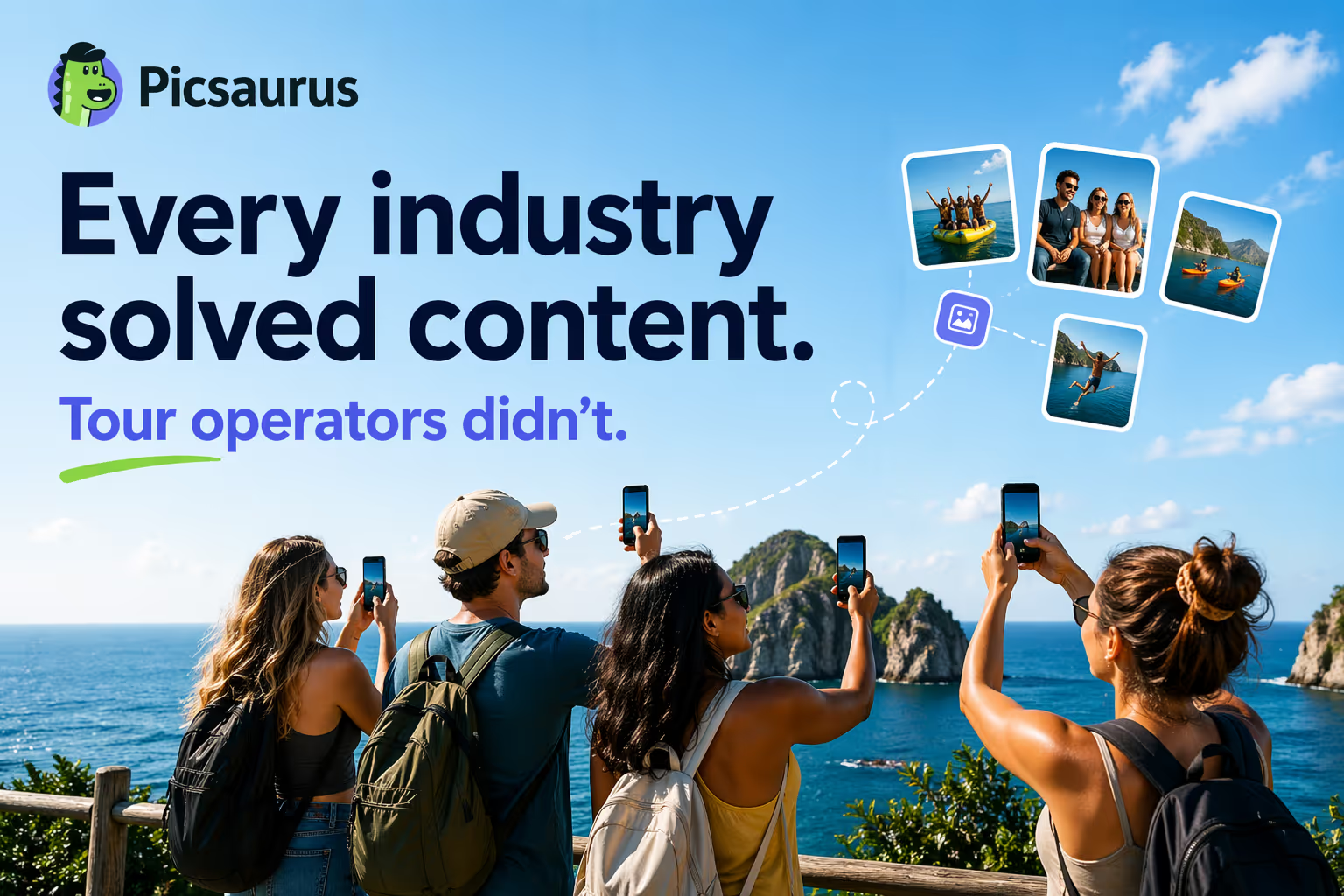
The Unique Challenge of Experience-Based Content
Every other industry creates content in a controlled environment.
A hotel room exists in one place. A restaurant plate comes out of one kitchen. A retail product sits on one shelf. The content opportunity is predictable, repeatable, and easy to set up properly.
A tour happens in the wild.
On water. In mountains. Through city streets at unpredictable moments. With weather variables, group dynamics, and safety requirements that mean the person leading the experience cannot also be the person documenting it.
This is the root of the problem. Not a lack of technology. Not a lack of awareness. A fundamental mismatch between where the best content gets created and who is positioned to capture it.
Guides cannot be photographers. The guide who is focused on getting a great shot is not fully focused on the guest next to them. And in experiences that involve safety considerations, that is not a trade-off worth making.
So the industry defaulted to whatever guides could manage between their actual responsibilities. Which meant inconsistent content, small volumes, and a constant feeling of being behind.
The Private Sharing Problem Nobody Talks About
Here is something interesting about the tour industry content problem.
It is not that content is not being created. It is that it is being created in exactly the wrong place.
Guests on a zipline tour, a food tour, a multi-day trek, a kayaking excursion: they are all taking photos. Lots of them. With significantly better cameras than most guides carry, at moments that are far more authentic than any posed group shot.
After the tour ends, those photos circulate. WhatsApp groups form. Google Photos albums get shared. AirDrops happen. The content moves freely and enthusiastically between the people who were there.
The operator is not one of those people.
No library. No usage rights. No full-resolution originals. No ability to use a single one of those photos in marketing without tracking down each individual guest and asking for permission in a way that feels awkward for everyone involved.
The industry has been sitting on a gold mine and handing the keys to private chat threads.
Why Previous Solutions Did Not Work
Over the years, operators have tried various approaches to this problem.
Photo packages sold at the end of the tour. Professional photographers hired for specific experiences. Staff trained to take phones out at key moments. Guest campaigns asking for photos after the fact.
Each of these has the same fundamental flaw: they require effort from someone.
Photo packages require a photographer to be present and a sales process at the end of the tour. Professional photographers are expensive and do not scale across multiple tours per day. Staff photography requires training, remembering, and consistent execution from people already managing complex responsibilities. Campaigns asking for photos get low response rates because the guest is long gone.
The industry kept trying to solve a systems problem with a people solution.
And people's solutions are inherently inconsistent.
The Shift That Changes Everything
Guest Sharing represents something genuinely new for the tour industry.
Not a new way to ask for photos. A new infrastructure for collecting them automatically.
The shift is from content collection as an action to content collection as a system. And that distinction changes everything about how reliable, scalable, and sustainable the solution is.
Here is what the shift looks like in practice.
The old model: tour happens, guide takes photos when possible, someone uploads them eventually, operator has whatever made it through.
The new model: tour happens, guests automatically receive a branded link, they share their own photos on tour, Picsaurus handles the branding for guests and delivers watermark-free, original resolution images to the operator's library, operator accesses a growing content pool with zero involvement.
The experience itself does not change. The tour is still the tour. Guides still do their job. Guests still do what they were already going to do.
What changes is that the operator is now included in a process that was already happening. The photos that were always going to be shared are now shared through a channel that works for the business, not just for the group chat.
What Privacy-First Actually Looks Like
One of the quieter innovations in Guest Sharing is what it does for guests, not just operators.
When guests form their own sharing groups through WhatsApp or similar tools, they expose personal information to strangers. Phone numbers. Email addresses. Sometimes full names. To an entire busload of people they met four hours ago.
Most guests do not think about this consciously. But it is a real friction point that reduces participation. Not everyone wants to hand their phone number to twelve strangers in exchange for tour photos.
Picsaurus removes this entirely. Guests share photos without exchanging any personal contact information. Nobody sees anyone else's number or email. The shared environment is controlled, purpose-built for tour groups, and closes after the sharing window ends.
For guests, this means a safer and more comfortable sharing experience. For operators, this means higher participation rates. When the barrier to sharing is lower, more guests share. More sharing means more content. More content means a stronger library.
Privacy as a product feature turns out to be a meaningful growth lever.
The Industry Is Catching Up
The tour industry creates extraordinary experiences. The content those experiences generate should match.
Not stock photos. Not posed shots at the trailhead. Not whatever the guide managed to grab between logistics calls.
Real moments. Captured by real guests. Flowing automatically into a library of full-resolution, rights-cleared originals that grows with every tour.
The hotel industry figured out that guests generate their best content. The restaurant industry figured it out. The tour industry is figuring it out now, and the operators who move first are the ones who will build the deepest libraries, the most authentic social feeds, and the strongest word-of-mouth loops.
The content problem is solved. The only question left is how quickly your operation gets to use the solution.
See how Guest Sharing works for your tours. Visit Picsaurus.com to activate.